ICASTICA 2015 | Jun 28 – Sep 28 | Arezzo Italy | Art director: Fabio Migliorati | Curators board: Adam Carr, Stefano Antonelli, Ilaria Gianni, Rita Selvaggio | I STREET section Curated by Stefano S. Antonelli | www.icastica.it
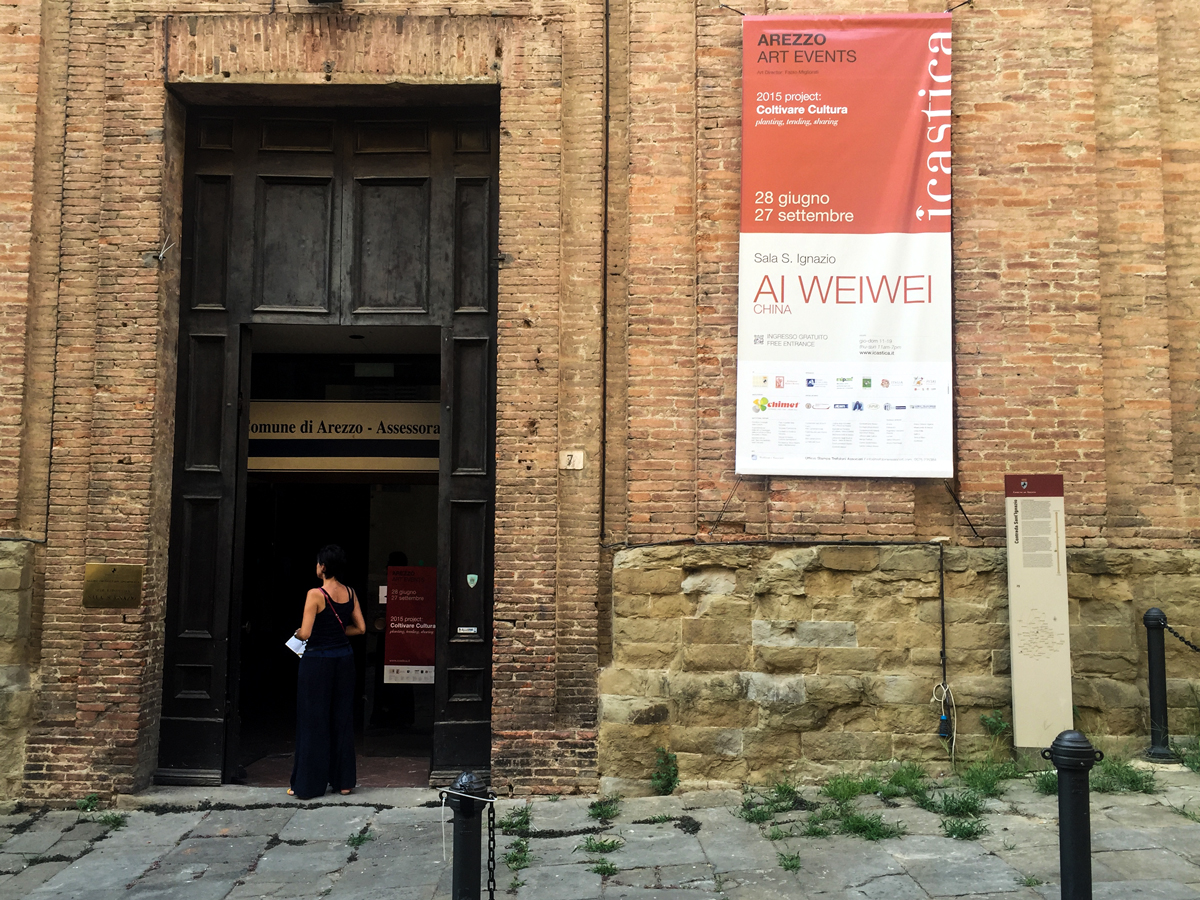 THE BARBARIAN INVASION
Curatorial notes by Stefano S. Antonelli
Barbarism is the name by which Nietzsche called the registry forces able to shatter the old borders and that’s what we want to make with our contribution to the 2015 festival edition, leaving in the city a permanent sign to indicate where the future begins. We didn’t place art in the city, but over city. Our art will not be packed to fly away after the festival but will leave as a gift to the city and the citizens. Arezzo, once again will be a protagonist at the forefront of the artistic germination ability that since the renaissance has influenced the whole world. The barbarians protagonists of this invasion are those artists who have chosen to bring down from the pedestal of art dedicated places to bring art in the daily life of all of us, the artists who left studios and canvases to choose our cities as support for their street art. For those who don’t know, Michelangelo is from Arezzo and the little bridge behind the Monna Lisa? Once again Arezzo. Although the Renaissance was invented in Arezzo and the presence of incalculable artistic masterpieces of medieval, renaissance and pre-renaissance period, the Tuscan town does not have an art tourism like Siena or Pisa which have an arsenal proportionally less in historical and artistic stuff. Arezzo had great economic seasons over the last 30 years thanks to the clothing industry first, and then gold industry. That economy is then bent to the economic crisis and the physiological trend of economic cycles, leaving the city to deal with its traditional values: artistic and historical heritage, but they was not enhanced in time to allow a thriving tourism cultural industry. A low coefficient of art therefore in a city which the entire West is artistically debtor and for which we have designed a series of public interventions. The wall paintings have been placed in the historic district, some surfaces dating back to 1300. What we wanted to achieve is to break the city monotonous continuity of medieval and pre-renaissance aesthetics leaving a contemporary sign trough the expressions of the non-academic urbanised art experience which invaded western cities in that last decade. We made it.
[rocketgalleries id=”3″]
I STREET sect. interventions
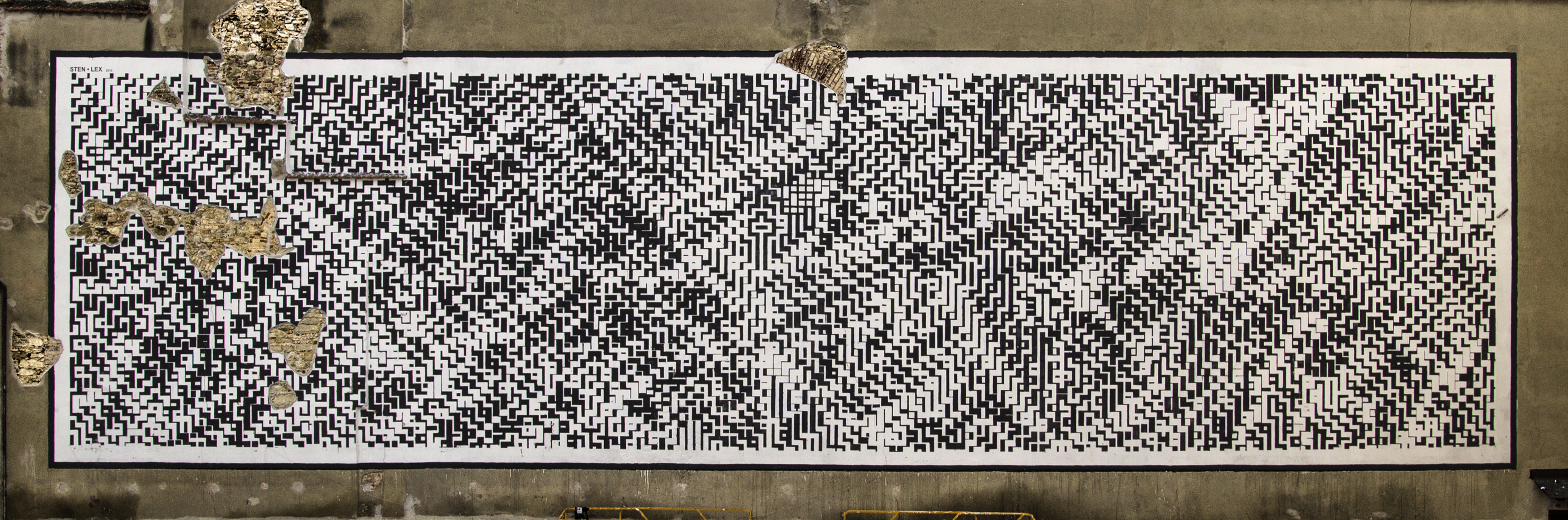
Sten Lex (It)
Pesaggio urbano II, 2015
Stencil poster, acrylic on wall
22×12 mt (867×473 in)
The audacious Sten & Lex reflections have taken shape on the 1300 Mercy church side large wall injecting the surface with the thin matrices that made their work so peculiar. The work is a representation of a fresco by Piero della Francesca ‘s cycle “The Stories of the True Cross ” detail (which is far 50 meters as the crow flies). A detail of a 1460 fresco becomes sampled material for STEN † LEX antidigital patterns synthesis imagined to take charge of amplifying the distant echo of this pre – Renaissance masterpiece to bring it back to the streets , among the people , through a contemporary language in an effort that crosses all their work, to re-tighten the space of the relationship between tradition and innovation.
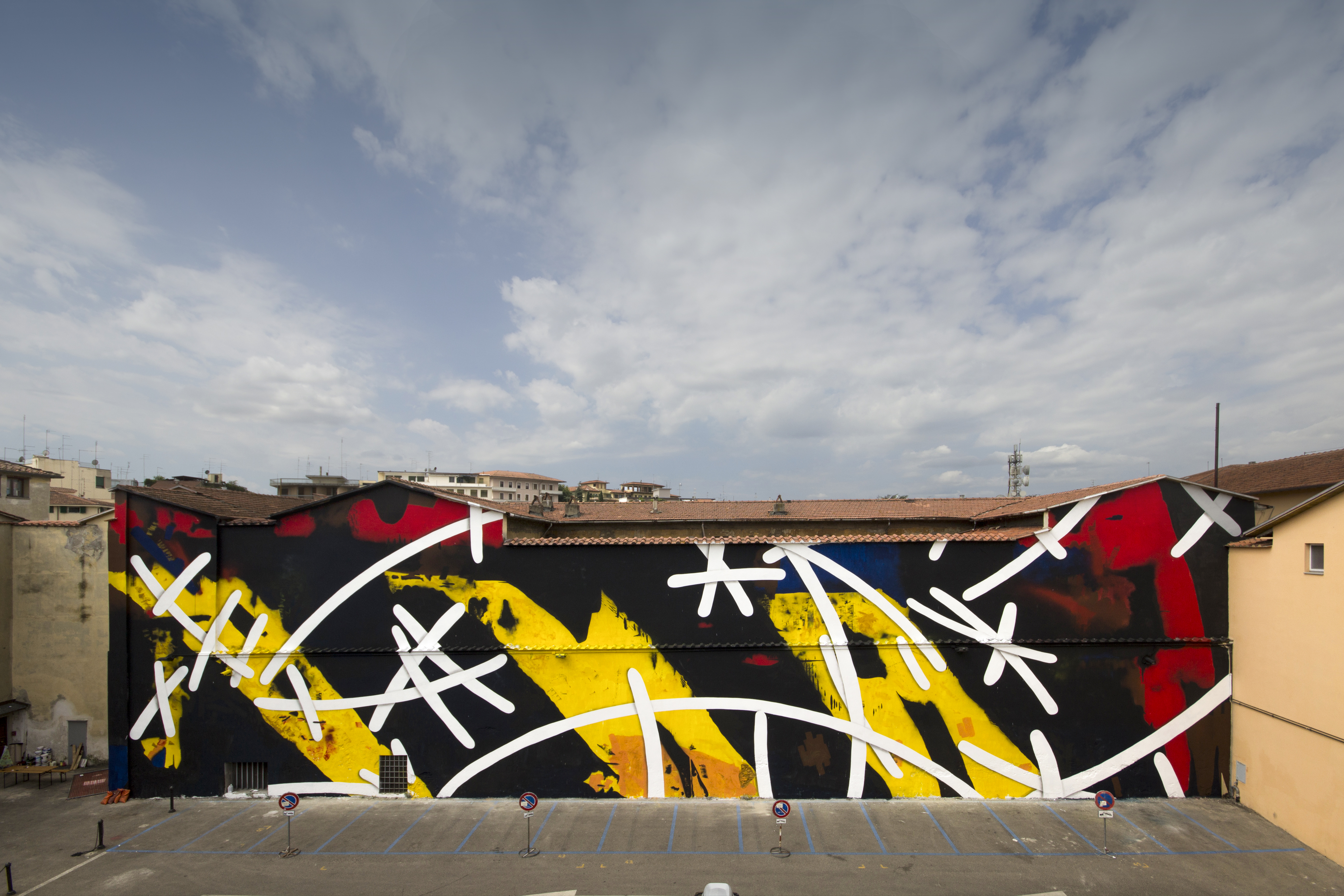
Moneyless (It)
Arezzo I, 2015
Acrylics and spraycan on wall
41×14 mt (1614.2×553 in)
Moneyless geometrism here becomes monumental to face the walls of the former Cadorna military base. A shocking explosion of sign and colour fills the space entrusting the role of interpreter of a real geometry of existence. To paint this surface, the artist used a specific tool able to project and control huge quantities of sprayed acrylic on the surface, that allowed the artist to actually paint in these dimensions, the colour shapes you can see in the background are the result of real pictorial body movements.
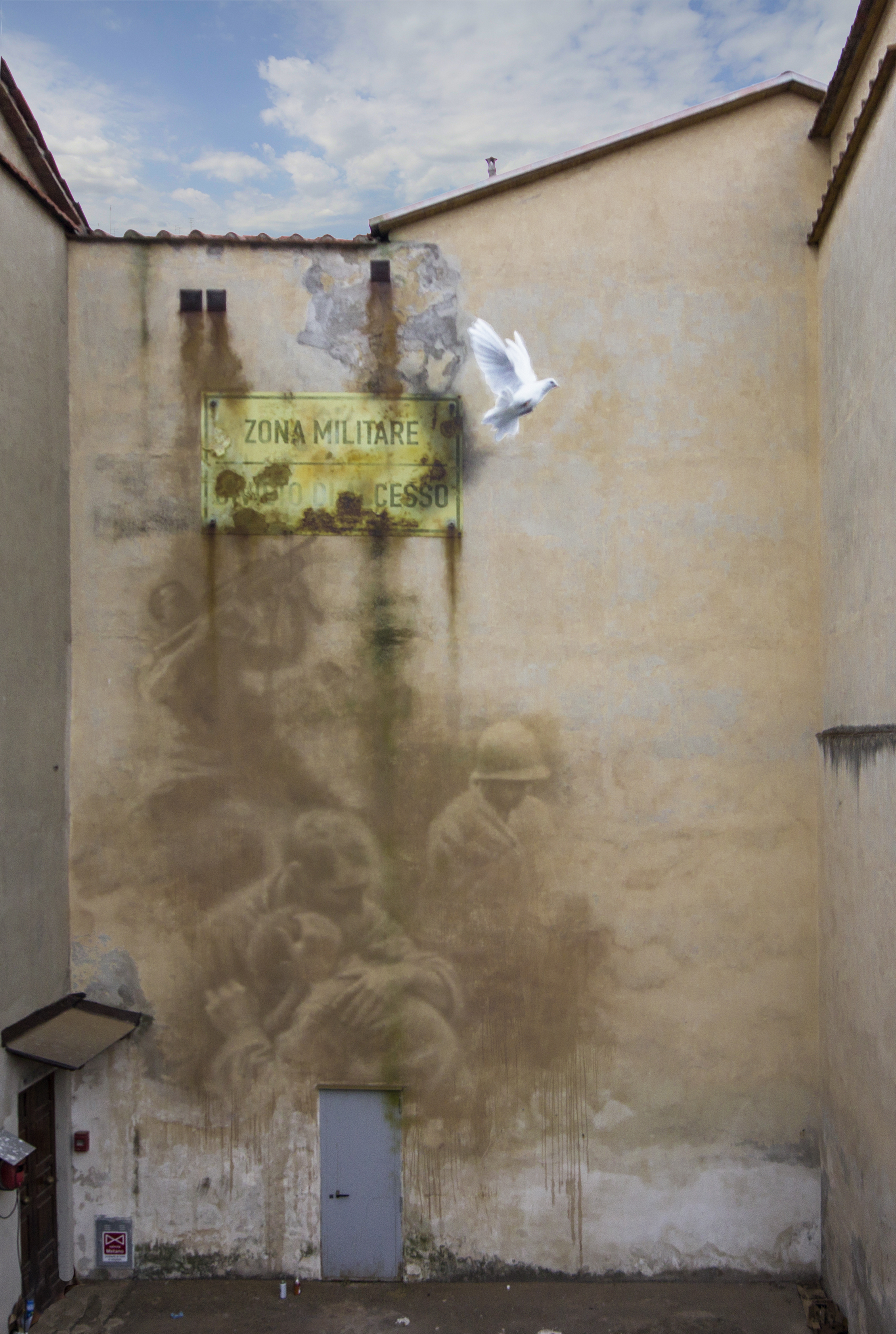
Eron (It)
Soul of the wall / Arezzo, 2015
Acrylics, spraycan and printed polycarbonate on wall
8×14 mt (315×552 in)
This artist is the interpreter of a unique technique and a rare sensitivity. The work is part of the cycle ” Soul of the wall” a series about the wall capability to resurface images from its past. The artist evokes through light smoky traces, figures and signs belonging to the protagonists of past stories of the spot. Contextual studies has highlighted the military history of the spot that Eron summarized in a “military zone” inhabited by protagonists of every war, suffering, pain and hope. Now the spot is a parking lot, this work is here to remember to new generations, here was dropped the hugest bomb of the area during the Second World War.
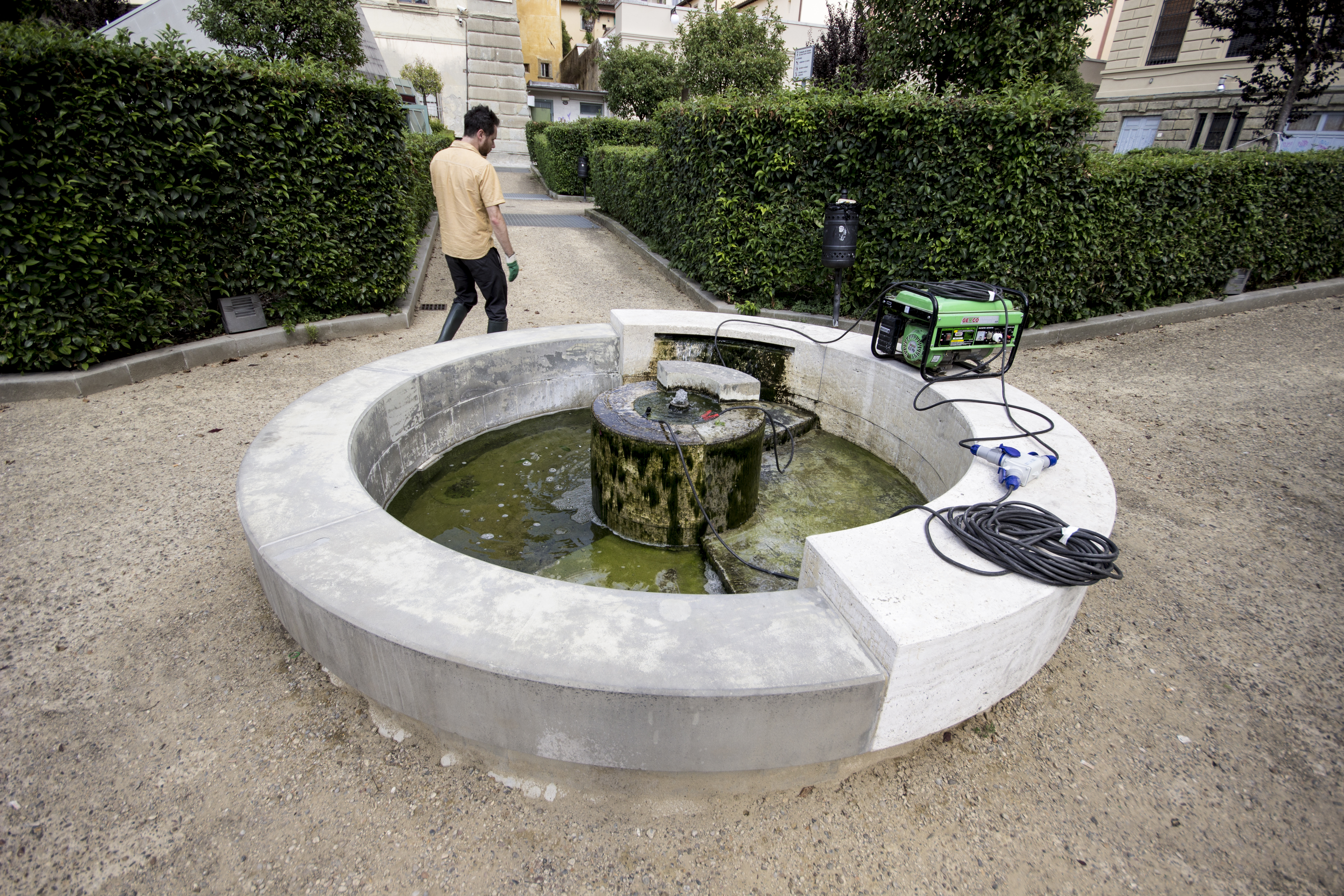
Brad Downey (USA)
220 Volte (1° volta), 2015
Lambda print on aluminium
Electrified fountain, site specific installation
AC generator, electric cables, industrial multiphase plug & splitter, rubber gloves, rubber boots, water, fountain
100x70cm (39x20in)
This work is about public trust. What happens when you put 220 volts in a public fountain? We asked people to trust us, to touch the water, nobody did it. We will not reveal what happens if you put your finger in the water but trust us, don’t do it in your town fountains. Before performing the installation in the public space, the artist did an experiment in a private space, we want to thank villa I Bossi and Albergotti family to let us use their magnificent mansion for our experiments. Enjoy the artist proof video.
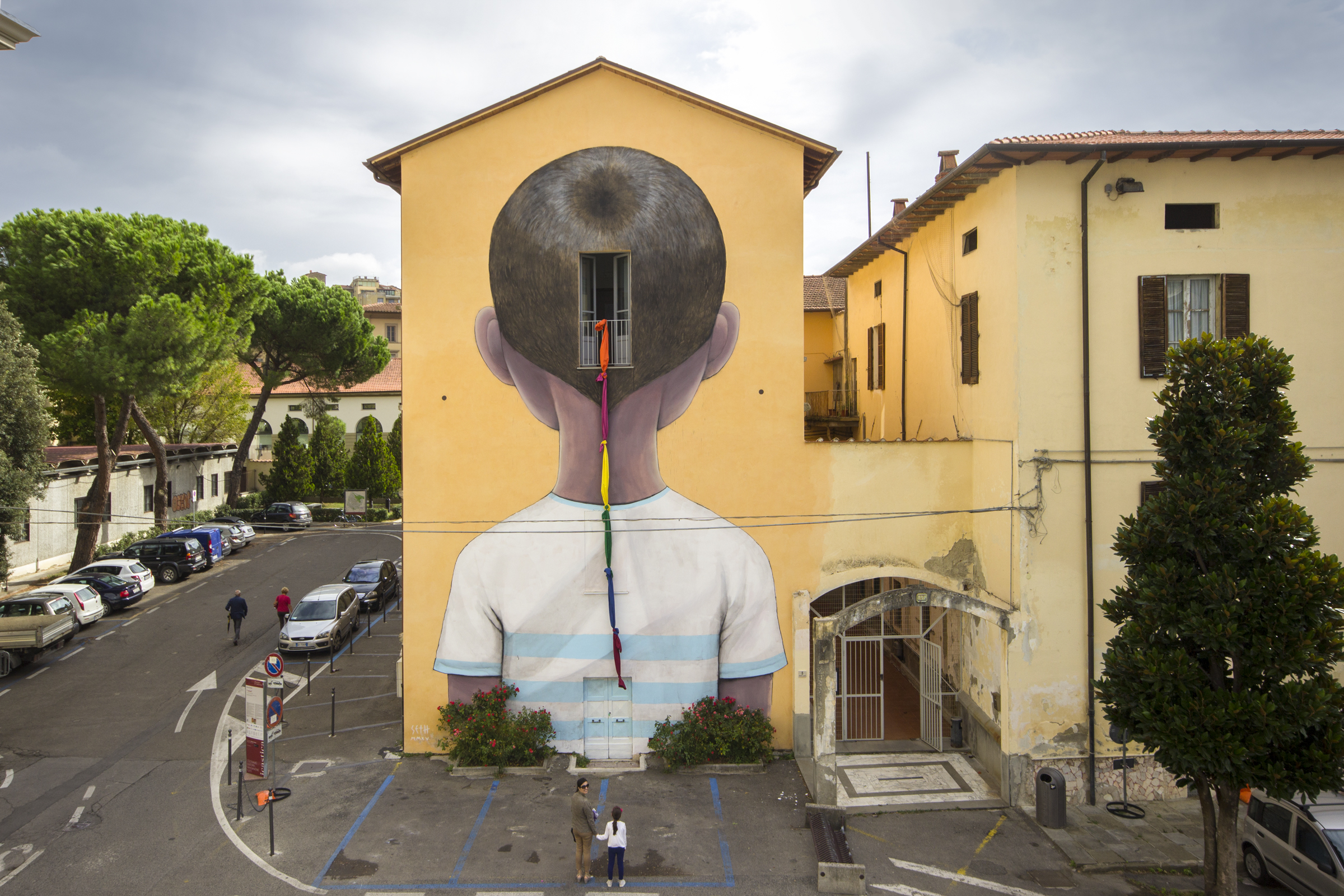
Seth (Fr)
Escape, 2015
Acrylics, spraycan and knotted sheets on wall
12×14 mt (473×552 in)
Seth is a unique interpreter of a lost childhood vision. Through his universal language the artist spurs the public to think outside of the box. Escape is an exhortation to consider to run away form your own thought, take a vacation and see if everything look similar when you’re back. This site specific work is a real visual shock for the city as Arezzo is a full coherent medieval town.
IMAGE GALLERY
[rocketgalleries id=”2″]
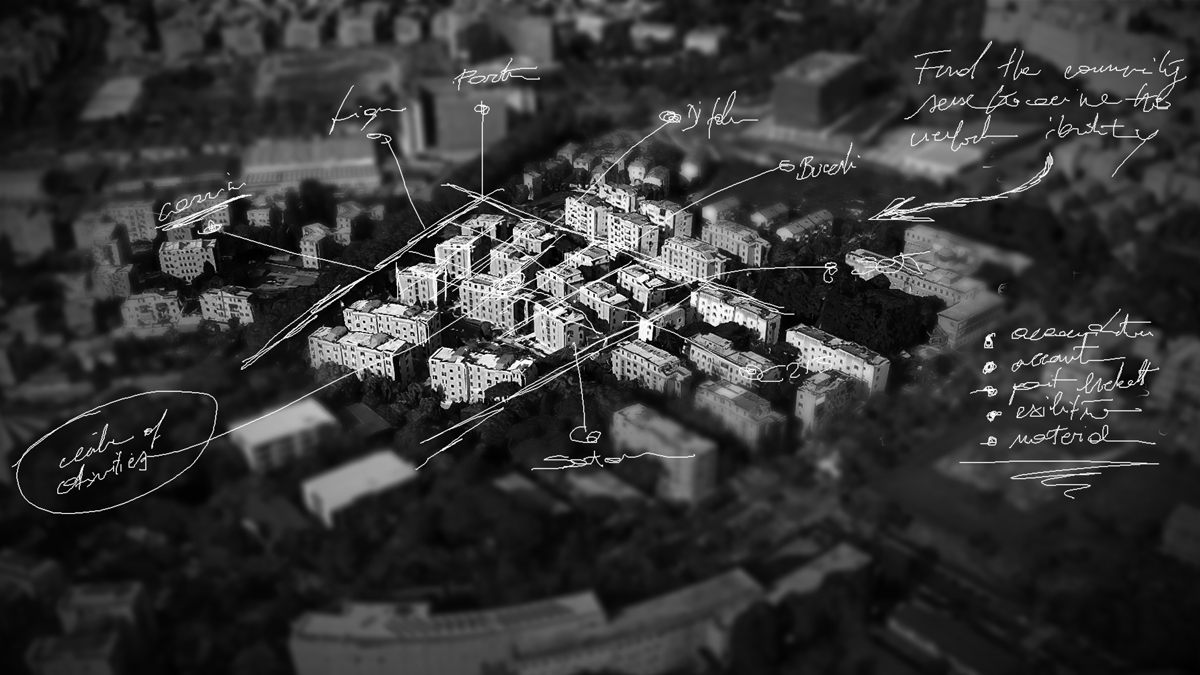 BIG CITY LIFE è il progetto di arte pubblica partecipata per la riqualificazione urbana, culturale e sociale di quelle zone grigie della città partendo dal quartiere storico di Tor Marancia, che ha preso il via l’8 gennaio scorso per concludersi il prossimo 27 febbraio. Ideato da 999Contemporary, organizzato da Francesca Mezzano e curato da Stefano S. Antonelli e Gianluca Marziani, il progetto è sostenuto economicamente da Roma Capitale Assessorato alla Cultura, Creatività, Promozione artistica e Turismo, da Fondazione Roma-Arte-Musei, dalla stessa l’associazione culturale 999Contemporary e condiviso con ATER del Comune di Roma, l’azienda territoriale per l’edilizia residenziale del Comune di Roma, con lo scopo di trasformare la borgata romana in un distretto di arte pubblica contemporanea unico al mondo, coinvolgendo in questo processo la comunità locale, le scuole e le associazioni di quartiere. Gli oltre cinquecento abitanti delle case popolari dello storico lotto 1 di Tor Marancia di proprietà ATER del Comune di Roma, incontreranno venti artisti, convenuti a Roma da dieci diversi paesi per dipingere l’intero quartiere. L’opera realizzata da ogni artista sarà il risultato di questo incontro per un totale di venti dipinti murali monumentali, realizzati sulle facciate delle undici palazzine del comprensorio di via di Tor Marancia 63. Gli allievi della scuola elementare Dalla Chiesa, delle medie Settimia Spizzichino e dell’istituto superiore Caravaggio saranno i protagonisti dei laboratori creativi tenuti dagli artisti, mentre lo staff di 999Contemporary si occuperà dei laboratori professionali destinati all’associazione culturale Rude, costituita dai ragazzi di Tor Marancia appositamente per la promozione, manutenzione e valorizzazione del patrimonio artistico, che dal 27 febbraio prossimo farà di Tor Marancia un vero e proprio museo pubblico vivente aperto a tutti sette giorni su sette, ventiquattro ore su ventiquattro. Solo alcune opere, tuttavia, saranno visibili dalla strada, per ammirarle tutte bisognerà entrare nel comprensorio e per approfondire la visita, un libro e un documentario racconteranno genesi, difficoltà, intenzioni, entusiasmi e le opere di questa incredibile avventura tra arte, azione, educazione ma soprattutto: partecipazione. Dal 27 febbraio Roma avrà un’attrazione tutta nuova che avrà come protagonista l’arte urbana contemporanea attraverso le espressioni di venti tra i suoi più importanti interpreti internazionali, unica nel suo genere e nel segno della continuità storica alla vocazione di questa città di ospitare la migliore arte del mondo da oltre duemila anni. BIG CITY LIFE è patrocinato da Roma Capitale Municipio Roma VIII che già vanta nel suo territorio oltre quaranta grandi opere nel quadrante tra il quartiere Ostiense e San Paolo, in quello che il New York Times ha definito l’Ostiense District, ed è realizzato in collaborazione con Atac e l’agenzia di comunicazione Pescerosso ma è solo grazie alla sponsorizzazione tecnica di Sikkens, che il progetto garantirà durata museale dei dipinti grazie alla straordinaria qualità dei materiali disponibili sul mercato.